
You’re standing there googling how to grind coffee without a grinder, half awake, staring at a bag of beans like they personally offended you, and yeah… I get it, you just wanted coffee, not a whole situation. It’s that small panic where you realize, oh, beans aren’t powder magically, who knew, and now you’re improvising like some kitchen survival show contestant but without the dramatic music.
Thing is, you actually can get decent coffee out of whole beans without a grinder, and not in a “this is fine I guess” way, more like surprisingly okay if you do it right-ish. The trick isn’t fancy tools, it’s kinda controlled chaos and not overthinking it (but also thinking just enough).
why grind size kinda matters (even when you’re winging it)
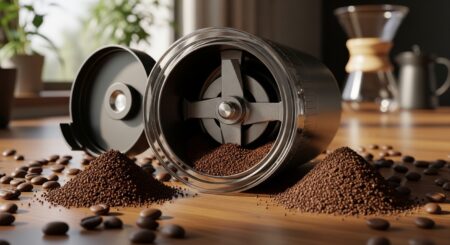
Before we start smashing beans like it’s revenge therapy, just know grind size affects taste more than people expect, like a lot more than your mug choice or whatever aesthetic thing you saw online. According to the Specialty Coffee Association, extraction depends heavily on surface area, meaning smaller particles extract faster, bigger ones slower, which is annoyingly important even when you’re doing it the scrappy way.
If you mess it up a bit, not the end of the world. But if everything is wildly uneven, you’ll get a weird mix of bitter and sour that makes you question your life choices slightly.
quick reference: grind size vs brewing method
| Brewing Method | Ideal Grind | What to aim for without a grinder |
|---|---|---|
| French Press | Coarse | Chunky, uneven but big pieces |
| Drip Coffee | Medium | Sand-ish texture, kinda clumpy |
| Espresso | Fine | Honestly… don’t try this without a grinder |
| Pour Over | Medium-fine | Between sand and sugar feel |
Yeah, espresso is basically off the table unless you enjoy disappointment, just saying.
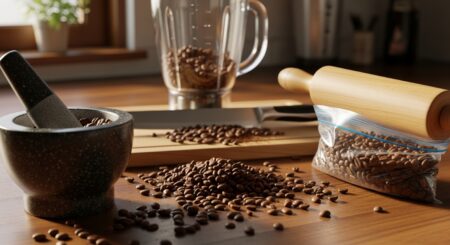
method 1: use a blender (the loud chaos approach)
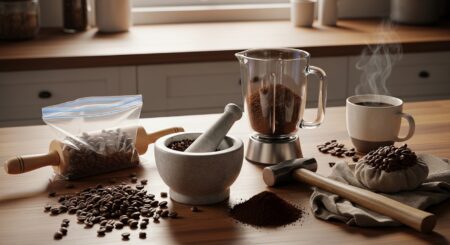
If you’ve got a blender, you’re already halfway there, though it does feel like overkill for coffee beans, like using a chainsaw to cut bread.
how to do it
- Add a small amount of beans (don’t dump the whole bag, that’s a mistake waiting to happen)
- Pulse in short bursts, not continuous blending
- Shake the blender between pulses to even things out
You’re not trying to liquify them (please don’t), just break them down gradually. Pulsing is key here, otherwise you get powder at the bottom and chunky rebels at the top refusing to cooperate.
“Short bursts reduce heat buildup, which can degrade coffee flavor compounds.” — Journal of Food Science, 2016
Heat is sneaky, it ruins flavor quietly, like overcooking garlic except less obvious.
what you’ll get
It’s gonna be uneven, let’s not lie to each other, but for drip coffee or pour-over, it’s usually passable. Not café quality, but definitely drinkable without regret spiraling.
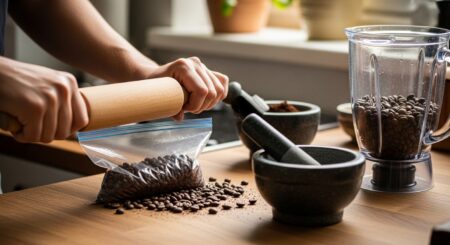
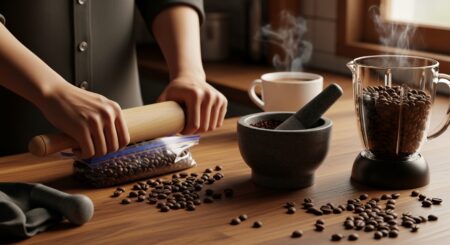
method 2: rolling pin (old school, slightly aggressive)
This one feels weirdly satisfying, like you’re baking but also kinda mad at the beans. Works better than you’d think though.
steps
- Put beans in a ziplock bag or between two sheets of parchment
- Press down first to crack them
- Then roll over them to grind finer
Don’t just start rolling immediately, you gotta crack them first or they’ll just slide around like tiny stubborn marbles.
pros and cons
Pros:
- No electricity needed (very apocalypse-friendly)
- You control the pressure pretty easily
Cons:
- Takes effort, like actual physical work (ugh)
- Can be inconsistent unless you’re patient (which… are you?)
Still, for French press or cold brew, this method actually shines a bit, even if your arms complain.
method 3: mortar and pestle (slow but weirdly calming)
If you’ve ever seen one in your kitchen and ignored it, this is its moment. It’s not fast, not even slightly, but it gives you more control than most other methods.
how it works
- Add small batches of beans
- Press and twist, don’t just smash randomly
- Gradually refine the grind
This one feels almost ceremonial, like you’re doing something ancient and important, even though it’s just coffee. But yeah, consistency is better here if you don’t rush it.
According to a study published in Food Research International, manual grinding methods like mortar and pestle can produce more uniform particle sizes compared to blade-based methods when done carefully. Which is surprising, but also kinda cool.
method 4: hammer (yes, really)
Okay listen, this sounds chaotic and it kinda is, but in emergencies… it works.
what you do
- Put beans in a thick bag or wrap in a towel
- Use a hammer or heavy object
- Tap, don’t go full demolition mode
You’re aiming for controlled hits, not destruction. If you go too hard, you’ll just pulverize some beans and leave others untouched, which is… not ideal.
real talk
This is more of a “I have no other options” method, but hey, it gets the job done. Think coarse grind, think French press, think survival coffee vibes.
method 5: food processor (somewhere between blender and chaos)
A food processor is kinda like a blender’s calmer cousin, though still not perfect for grinding coffee.
steps
- Add beans in small batches
- Pulse repeatedly
- Shake container between pulses
You’ll get slightly better consistency than a blender, mostly because the blades and space work differently, but still uneven, just less offensively so.
small tricks that make a big difference
This is the part people skip, and then they’re like “why does my coffee taste weird,” and it’s usually because of one of these things.
don’t grind too much at once
Smaller batches = more control. Big batches = chaos and regret.
sift if you can
If you have a sieve, use it. It separates finer particles from larger chunks, giving you a more consistent brew, even if it feels extra.
avoid heat buildup
Heat messes with oils and flavor compounds. That’s not me being dramatic, it’s chemistry being annoying.
match grind to brew
Even if it’s imperfect, try to aim roughly for the right grind size. That alone improves taste a lot more than people expect.
what about taste, like honestly?
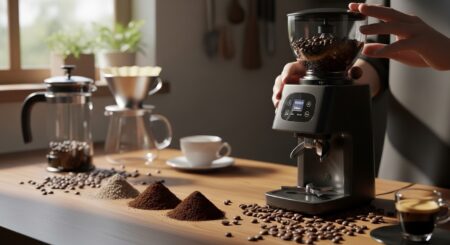
Let’s not pretend this is the same as a burr grinder experience, it’s not, and your coffee nerd friend will definitely notice. But for everyday drinking, especially if you just need caffeine and comfort, it’s honestly fine, sometimes even kinda good.
In a survey by the National Coffee Association, about 62% of Americans drink coffee daily, and not all of them are using precision grinders or weighing beans down to the gram. Most people are just… making it work, and that’s okay.
common mistakes you’ll probably make (and it’s fine)
- Grinding too fine accidentally and getting bitter coffee
- Leaving chunks too big and getting weak, sour coffee
- Overheating beans in a blender
- Expecting perfection (this one’s big, like really big)
You’ll mess it up a bit the first time, maybe the second too, but then you kinda get a feel for it, like muscle memory but for coffee chaos.
should you just get a grinder though?
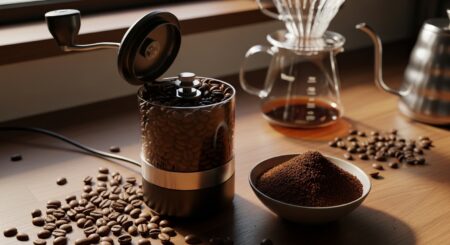
Yeah… eventually, probably. A decent burr grinder isn’t crazy expensive anymore, and it does make a difference, especially if you care about consistency and flavor clarity.
But also, not having one shouldn’t stop you from making coffee. That’s the main thing here, you’re not locked out of coffee just because you don’t own a specific gadget, that would be ridiculous.
final thoughts (or whatever this is)
So yeah, how to grind coffee without a grinder isn’t really about perfect technique, it’s more about making do, adjusting, kinda experimenting a bit without overthinking every tiny detail. You’ve got options, more than you thought probably, and most of them actually work well enough to get you a solid cup.
Next time you’re stuck with whole beans and no grinder, you won’t just stare at them like they’re a puzzle, you’ll just… deal with it, maybe with a rolling pin or a blender or something slightly chaotic, and it’ll be fine. Not perfect, but fine in that comforting, “this still counts as coffee” kinda way.