
You’re standing there with whole beans and suddenly realizing how to grind coffee beans without a grinder is not something you ever bothered learning before, and now your morning is kinda depending on it, isn’t it. It’s a weirdly specific problem, but also super common—like, you have coffee, just not in the right shape.
The good news is, yeah, you can still make a decent cup. Maybe even a great one if you don’t mind a little chaos in the process.
Let’s get into it.
Why You Might Need to Grind Coffee Beans Without a Grinder
Sometimes it’s not about being unprepared. It’s just life being… life. Maybe your grinder broke, maybe you’re traveling, maybe you just bought whole beans thinking “this feels fancy” and now regret has entered the room.
Whole beans stay fresh longer, that part’s true. According to the Specialty Coffee Association, ground coffee begins losing flavor within minutes after grinding due to oxidation. Whole beans, though, can hold their flavor for weeks if stored properly. So technically, you did a smart thing. Just… skipped a step.
Now we improvise.
What You Should Know Before You Start
Before you go smashing beans like you’re mad at them (valid), there are a couple things to keep in mind:
- Consistency matters more than perfection
- Different brewing methods need different grind sizes
- You’re probably not going to get café-level results, and that’s okay
Here’s a quick reference:
| Brewing Method | Grind Size Needed |
|---|---|
| French Press | Coarse |
| Pour Over | Medium |
| Espresso | Fine |
| Cold Brew | Extra Coarse |
If your grind is uneven, your coffee might taste… off. Bitter in some sips, weak in others. But honestly, still drinkable.
Method 1: Use a Blender
How it works
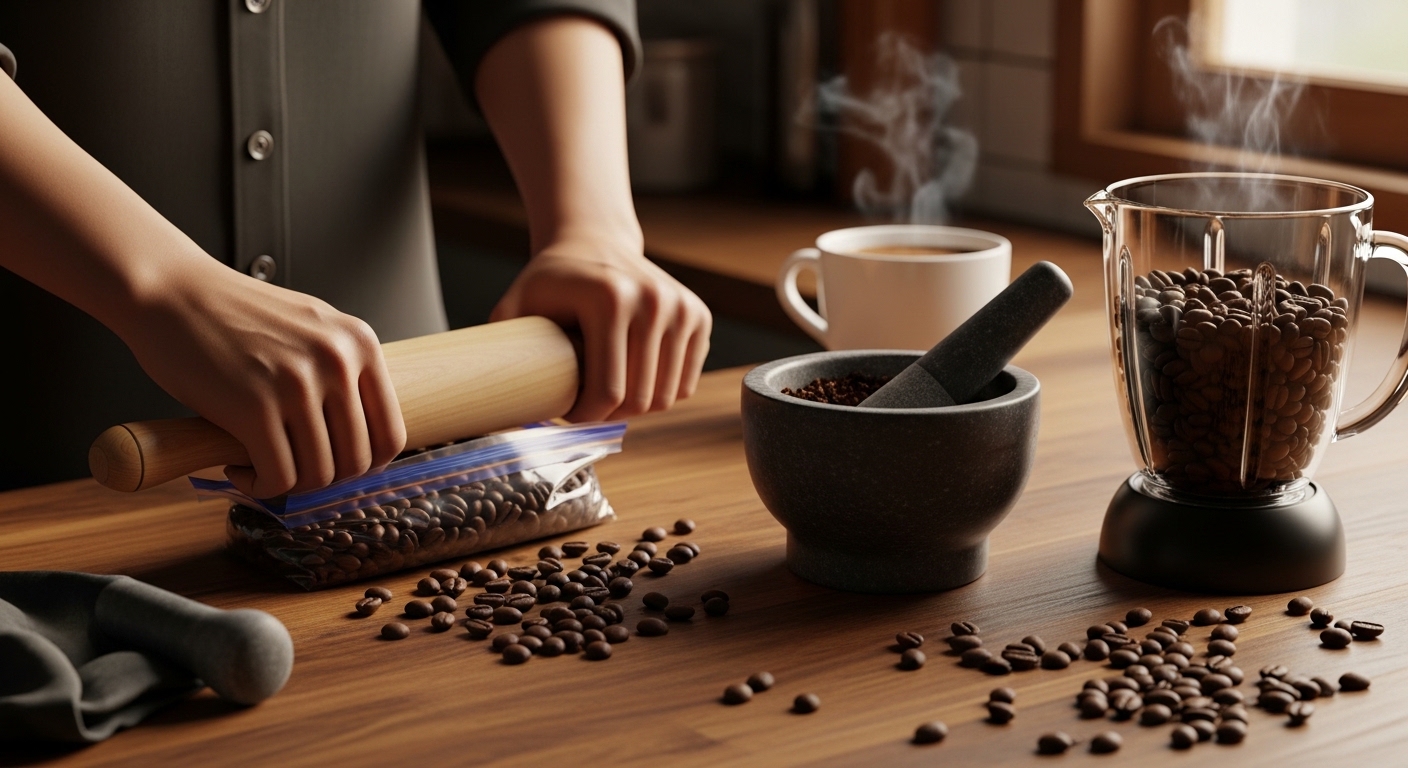
If you’ve got a blender, you’re already halfway there. It’s basically a loud, aggressive grinder in disguise.
Steps
- Add a small amount of beans (don’t overfill, seriously)
- Use the pulse setting instead of continuous blending
- Shake the blender slightly between pulses to even things out
What to expect
You’ll get a somewhat uneven grind. Some bits will be powdery, others chunky. It’s not perfect, but it works, especially for drip coffee or French press if you’re patient-ish.
“Blenders can mimic burr grinders in a rough way, but lack precision,” notes a study from the Coffee Science Foundation.
Yeah, “rough way” is doing a lot of work in that sentence.
Method 2: Mortar and Pestle (Old School, But Weirdly Satisfying)
Why this actually works well
This is one of the better ways to grind coffee beans without a grinder, surprisingly. It gives you control, even if it takes a bit more effort.
Steps
- Add a small batch of beans
- Start crushing gently, then grind in circular motions
- Keep going until you reach your desired consistency
Pros
- More control over grind size
- Better consistency than most DIY methods
Cons
- Takes time
- Your arm might start questioning your life choices
Still, if you want something closer to a proper grind, this is one of the better options.
Method 3: Rolling Pin (Or Any Heavy Bottle, Honestly)
This one feels a bit chaotic, but it works in a pinch.
Steps
- Place beans in a ziplock bag
- Lay it flat on a hard surface
- Use a rolling pin (or wine bottle, no judgement) to crush and roll
Tips
- Press down first to crack the beans
- Then roll to refine the grind
You’ll probably get a mix of coarse and medium pieces. Good enough for French press or even cold brew.
Also, it’s kinda therapeutic. In a mildly destructive way.
Method 4: Hammer Time (But Like, Carefully)
Yes, this sounds extreme. But sometimes you gotta do what you gotta do.
Steps
- Put beans in a thick bag or between towels
- Place on a sturdy surface
- Tap (not smash aggressively) with a hammer
Important note
Don’t go full action-movie mode here. You’re crushing beans, not breaking concrete.
Result
Very uneven grind. Probably better suited for cold brew, where precision isn’t as critical.
Method 5: Knife (Not As Dangerous As It Sounds… Mostly)
Using a large chef’s knife, you can crush beans by pressing down on them.
Steps
- Place beans on a cutting board
- Lay the flat side of the knife over them
- Press down firmly
Repeat until you get the grind you need.
This method is a bit awkward, honestly. But it works if you’re careful.
Method 6: Food Processor
This is similar to a blender but slightly more forgiving.
Steps
- Add beans
- Pulse in short bursts
- Shake occasionally
Still uneven, but slightly better control compared to a blender.
Comparing the Methods
Here’s a quick breakdown of what works best depending on your situation:
| Method | Effort Level | Consistency | Best For |
|---|---|---|---|
| Blender | Low | Medium | Drip, French Press |
| Mortar & Pestle | High | High | Most methods |
| Rolling Pin | Medium | Medium | French Press |
| Hammer | Medium | Low | Cold Brew |
| Knife | Medium | Low | Emergency use |
| Food Processor | Low | Medium | General use |
Tips to Get Better Results (Even Without a Grinder)
This part matters more than people think.
1. Work in Small Batches
Trying to grind too many beans at once leads to uneven results. Always go small, even if it’s annoying.
2. Sift If You Can
If you have a sieve or strainer, you can separate finer particles from larger chunks. It’s a bit extra, but improves consistency.
3. Match Your Grind to Your Brew
Don’t overthink it, but also don’t ignore it completely. A super fine grind in a French press? Yeah, that’s gonna taste muddy.
4. Brew Immediately
Ground coffee loses flavor fast. Like, faster than you’d expect.
According to research published in the Journal of Food Science, volatile compounds responsible for aroma can dissipate within 15 minutes of grinding. So yeah, don’t grind and then go scroll your phone for half an hour.
Common Mistakes People Make
You’re probably going to mess up a little. Everyone does.
Here’s what to avoid:
- Grinding too long in a blender (you’ll burn the beans slightly)
- Not checking consistency
- Using too much force and making a mess
- Ignoring grind size completely
Also, don’t expect perfection. That’s not the goal here.
Does It Actually Taste Good?
Short answer: yeah, it can.
Long answer: it depends on how picky you are.
If you’re used to café-quality espresso, this might feel like a downgrade. But for most people, especially in a “I just need coffee right now” situation, it’s perfectly fine.
Sometimes even better, weirdly. There’s something about the process that makes it feel more… involved, I guess.
When You Should Probably Just Get a Grinder
Let’s be real for a second.
If you’re doing this regularly, it might be time to invest in a grinder. Manual grinders are affordable and give you way better control.
But for occasional situations? These methods are totally enough.
Final Thoughts
Figuring out how to grind coffee beans without a grinder isn’t really about doing it perfectly—it’s about not letting a small obstacle ruin your coffee moment. You’ve got options, even if they’re a little unconventional, maybe slightly messy, and definitely not what baristas would recommend on a calm Tuesday afternoon.
Still, it works. And once you’ve done it once, you kinda realize you’re less dependent on tools than you thought, which is… oddly empowering in a small, coffee-related way.
So yeah, go crush those beans however you need to. Your coffee will still show up for you.