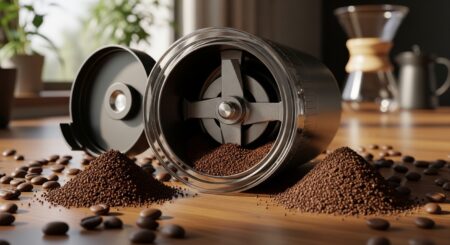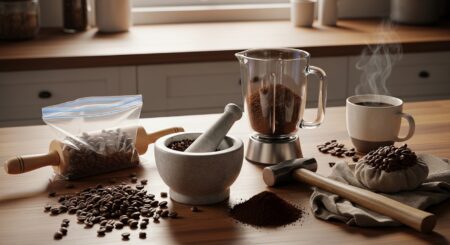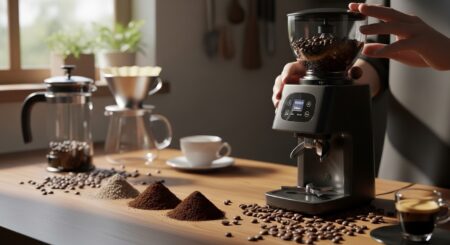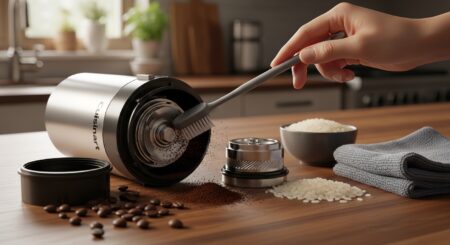

So you’re here trying to figure out how to grind coffee beans without grinder, probably because you just realized whole beans are useless chunks of stubborn rock without the right tool, and now you’re staring at them like… great, now what. Yeah, been there, it’s a slightly annoying little moment that somehow feels bigger than it should.
Let’s fix that. You don’t need fancy gear, honestly you don’t even need to be particularly graceful about it. You just need a bit of pressure, a bit of patience, and maybe a willingness to make a tiny mess. Coffee will forgive you.
Why grinding actually matters (even if you’re winging it)
Before we start smashing beans like a medieval apothecary, it helps to know why this matters at all. Grinding coffee beans changes how water extracts flavor — too coarse, and your coffee tastes like sad water pretending to be coffee; too fine, and suddenly it’s bitter like it’s holding grudges.
According to the Specialty Coffee Association, grind size directly affects extraction time and flavor balance. Which is a polite way of saying: yes, this step matters, even if you’re improvising with kitchen tools.
But don’t stress too much. You’re not calibrating a lab experiment, you’re just trying to get caffeine into your bloodstream in a decent way.
Methods to grind coffee beans without a grinder
Alright, here’s the fun bit. Or chaotic bit. Depends how your kitchen looks afterward.
1. Use a blender (closest thing to a real grinder, kinda)
If you have a blender sitting around, congrats, you’re already halfway to being functional.
How to do it:
- Pour a small amount of beans (don’t overfill, it gets uneven)
- Use short pulses, not continuous blending
- Shake the blender slightly between pulses (yes, really)
Blenders mimic blade grinders, which means:
- You’ll get uneven grounds
- Some bits will be powder, others… not so much
Still, it works surprisingly well for:
- French press (coarser grind)
- Drip coffee (medium-ish)
Just don’t go full tornado mode, or you’ll end up with dust and regret.
2. Food processor (loud, messy, but effective-ish)
A food processor is like the blender’s slightly more aggressive cousin.
Steps:
- Add beans in small batches
- Pulse repeatedly
- Check consistency every few seconds
You’ll notice something weird — beans tend to fly to the edges. So you might have to:
- Stop
- Scrape
- Pulse again
It’s a bit annoying, yeah, but it gets the job done. Not perfect, but honestly, neither is life before coffee.
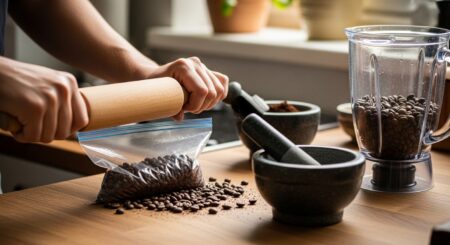
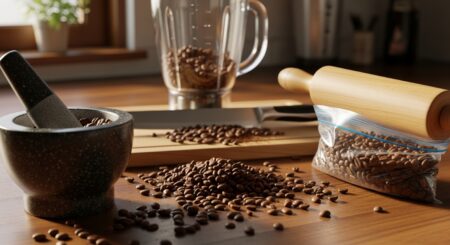
3. Mortar and pestle (old-school, surprisingly satisfying)
This is the method that makes you feel like you’re doing something ancient and important.
How to grind:
- Add a small handful of beans
- Press down firmly, then twist
- Repeat… and repeat… and repeat
This one gives you:
- More control over grind size
- A workout you didn’t ask for
It’s actually one of the better methods if you care about consistency, weirdly enough. Just takes time. And patience. And maybe a bit of stubbornness.
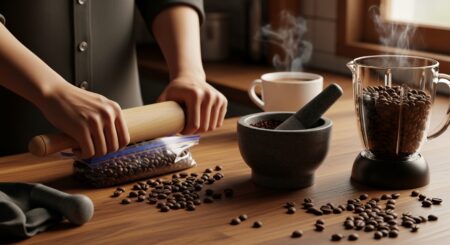
4. Rolling pin (yes, seriously)
If you’ve got a rolling pin, you’re basically ready to go.
Instructions:
- Place beans in a sealed plastic bag
- Lay it flat on a surface
- Roll over it with pressure
Then:
- Roll again
- And again
- And maybe once more because there’s always one bean refusing to cooperate
This method works best for:
- Coarse grinds
- French press or cold brew
It’s messy if the bag breaks, so… maybe double-bag it unless you enjoy sweeping.
5. Hammer or heavy object (controlled chaos)
This one feels a bit… aggressive, but it works.
What to do:
- Put beans in a thick bag or wrap in cloth
- Use a hammer, mallet, or even a heavy pan
- Tap, don’t smash like you’re breaking concrete
You’ll get:
- Very uneven grind
- A mix of sizes
But honestly, for something like cowboy coffee or French press, it’s fine. Coffee doesn’t judge you for using a hammer. Or at least it hasn’t said anything yet.
6. Knife method (not ideal, but doable)
If you’re desperate — like really desperate — you can use a large knife.
Steps:
- Place beans on a cutting board
- Lay the flat side of the knife over them
- Press down hard
It’s awkward. Beans shoot out sometimes. You’ll feel slightly ridiculous. But technically, yes, you’re grinding coffee beans without a grinder.
Comparing methods quickly (because choices get annoying)
| Method | Effort Level | Consistency | Best For |
|---|---|---|---|
| Blender | Low | Medium | Drip, French press |
| Food Processor | Medium | Medium | General use |
| Mortar & Pestle | High | High | Controlled grinding |
| Rolling Pin | Medium | Low | Coarse grind |
| Hammer | Low | Very Low | Emergency brewing |
| Knife | High | Very Low | Desperation mode |
Honestly, if you have options, go blender or mortar and pestle. The rest are… situational solutions.
Tips to get better results (even if you’re improvising badly)
Here’s where things get slightly more refined, but not in a pretentious way.
Use small batches
Grinding too many beans at once = uneven chaos. Smaller amounts = better control.
Aim for the right grind size
Different brewing methods need different textures:
- French press → coarse (like sea salt)
- Drip coffee → medium (like sand)
- Espresso → fine (like powder, but good luck doing that without a grinder honestly)
Don’t overdo it
Over-grinding can heat the beans, which affects flavor. You won’t ruin everything, but it might taste… off-ish.
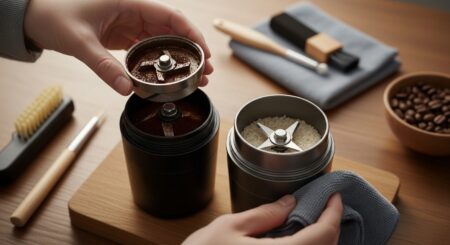
Clean your tools after
Coffee oils stick around. Next time you use your blender for a smoothie, you don’t want a hint of yesterday’s beans making things weird.
Real talk: will it taste as good?
Short answer: not quite.
Longer answer: it’ll still be good enough, and sometimes that’s exactly what you need.
A study published in the Journal of Food Engineering found that uniform particle size improves extraction efficiency by up to 20–30%. That’s nice and scientific, but in real life terms it just means: better grind = better flavor.
But imperfect grind doesn’t mean bad coffee. It just means… slightly less perfect coffee. Which is still coffee, and that’s kind of the whole point.
When you should probably just get a grinder (yeah, eventually)
Look, if you find yourself doing this regularly — like every morning turning into a mini construction project — it might be time to invest.
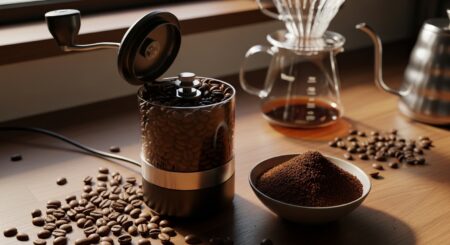
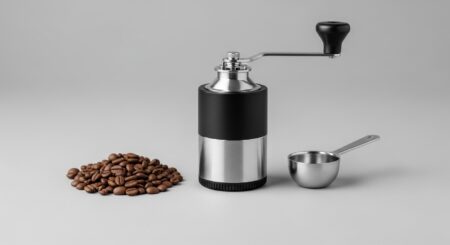
Manual grinders are:
- Affordable
- Portable
- Weirdly satisfying to use
Electric grinders are:
- Fast
- Consistent
- Less… chaotic
You don’t need to go fancy. Even a basic grinder will save you time, effort, and probably a few eye-roll moments.
Final thoughts (or, you survived this part)
So yeah, figuring out how to grind coffee beans without grinder isn’t exactly glamorous, but it’s very doable. You improvise, you adapt, maybe you make a bit of noise, and in the end you still get coffee. That’s the win.
And there’s something oddly satisfying about making it work with what you have. Like, sure, it’s not perfect, but neither is most of the stuff we do daily and it still turns out alright.
If you’re standing there right now with a bag of beans and no clue, just pick a method and start. You’ll figure it out faster than you think. And if it’s a little uneven? Eh, you’ll still drink it anyway, won’t you.