
You’re standing there with a bag of beans and suddenly realizing you never actually figured out how to grind coffee without a coffee grinder, and yeah… that moment feels a bit ridiculous, doesn’t it. Like you did everything right except the one step that actually matters. It happens more often than people admit, honestly.
Maybe your grinder broke, maybe you never bought one (fair), or maybe you’re somewhere weird like a hostel kitchen with exactly one spoon and a suspicious-looking pan. Either way, you’re here now, and we’ll make it work — not perfectly, but good enough that your coffee won’t taste like regret.
Why Grinding Matters More Than You Think (Even If You’re Improvising)
Here’s the slightly annoying truth: how you grind coffee affects almost everything about how it tastes. It’s not just coffee snob nonsense, even though it kinda sounds like it.
When beans are ground, they release oils and compounds that create flavor. But the size of the grind changes how fast water extracts those flavors.
- Too coarse → weak, sour-ish coffee
- Too fine → bitter, over-extracted mess
- Somewhere in between → actual drinkable coffee
According to the Specialty Coffee Association, consistency in grind size is one of the biggest factors in achieving balanced extraction. Not temperature, not even brew time sometimes. Grind.
So yeah, doing this without a grinder isn’t ideal. But we’re not aiming for perfection here — just “hey, this is actually pretty decent.”
The Tools You Probably Already Have (No Fancy Stuff)
You don’t need anything special. In fact, the more normal your kitchen is, the better your odds.
Here’s what tends to work:
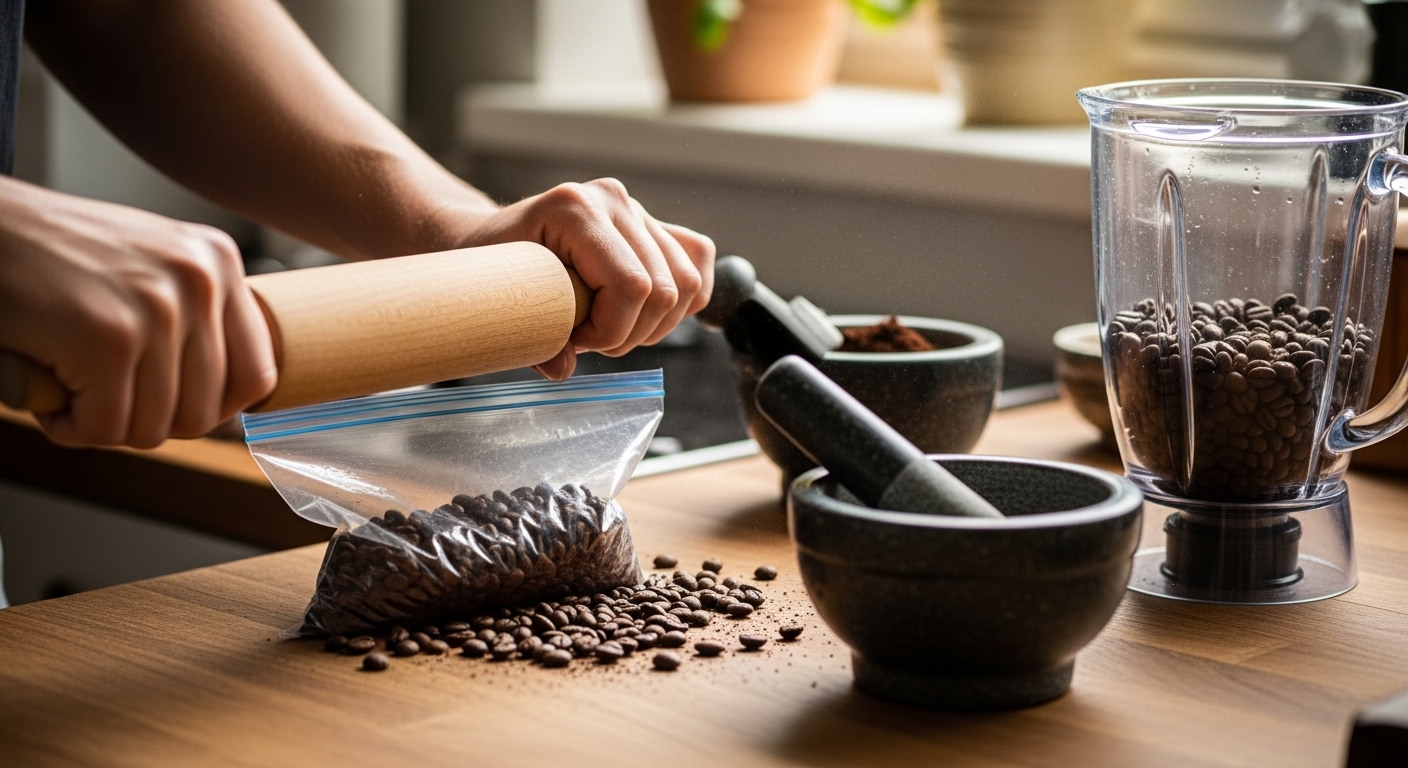
- A rolling pin (or wine bottle… same energy)
- A mortar and pestle (if you’re fancy or cook a lot)
- A hammer or meat tenderizer (controlled chaos)
- A blender or food processor
- Even just a pan and some determination
You’re basically replacing a grinder with brute force and patience, which is… not elegant, but effective-ish.
Method 1: Crushing Beans with a Rolling Pin (Surprisingly Therapeutic)
This is probably the easiest way to grind coffee without a coffee grinder, especially if you don’t wanna deal with noise or electricity.
How to do it:
- Put your coffee beans in a sturdy ziplock bag
- Press out the air (important, or it’ll pop and you’ll hate everything)
- Start gently crushing with the rolling pin
- Once cracked, roll over them like you’re flattening dough
It’s not fast. It’s not clean. But it works.
What you’ll get:
- Uneven grind (some chunks, some powder)
- Better for French press or cold brew
There’s something oddly calming about it though, like you’re solving a problem in a very physical, caveman way.
Method 2: Mortar and Pestle (Old School, But Kinda Perfect)
This is technically one of the best manual ways, even better than some cheap grinders.
People have been doing this forever, way before electric grinders were even a thing. And honestly, it shows.
Steps:
- Add a small amount of beans at a time
- Press and twist instead of just smashing
- Keep going until you reach your desired texture
Why it’s good:
- You control the grind size better
- More consistent than most DIY methods
- Doesn’t make a huge mess
It takes effort, though. Like, your arm will notice.
But if you want something close to an actual grind without a grinder, this is probably your best bet.
Method 3: Blender or Food Processor (Fast but Messy Results)
Okay, this is the “I need coffee NOW” method.
Most people have access to a blender at least, and yes — it can grind coffee beans. Just… not very evenly.
How to use it:
- Add a small batch of beans
- Pulse, don’t blend continuously
- Shake the container between pulses
Reality check:
Blenders don’t grind evenly. They chop randomly. You’ll get a mix of fine powder and chunky bits.
But honestly? It’s fine for:
- Drip coffee
- Pour-over (if you’re forgiving)
A study published in the Journal of Food Engineering (2016) noted that inconsistent particle sizes can lead to uneven extraction, but unless you’re judging a coffee competition, you probably won’t notice that deeply.
Method 4: Hammer or Meat Tenderizer (Yes, Really)
This feels a bit ridiculous at first, but it works in a very… aggressive way.
Steps:
- Put beans in a thick bag or wrap in a cloth
- Place on a hard surface
- Tap gently at first (don’t go full chaos mode immediately)
- Increase force as needed
Important note:
You’re crushing, not annihilating. If you go too hard, you’ll get powder and possibly damage your countertop, which is a whole different problem.
Best for:
- Coarse grind
- French press or cowboy coffee
Also, it’s kinda satisfying. Not gonna lie.
Method 5: Pan Grinding (Weird, But Works in a Pinch)
This one feels like something someone figured out out of desperation, and yeah, that’s exactly what it is.
What you do:
- Place beans in a sturdy pan
- Use the bottom of another pan or glass to press and crush
- Move around constantly
It’s awkward. It’s noisy. But if you have literally nothing else, it’ll get you somewhere.
Grind Size Guide (So You Don’t Completely Guess)
Here’s a quick reference, because guessing blindly is… not ideal.
| Brewing Method | Grind Type | DIY Method Fit |
|---|---|---|
| French Press | Coarse | Rolling pin, hammer |
| Pour Over | Medium | Blender, mortar |
| Espresso | Fine | Mortar only (and still tricky) |
| Cold Brew | Extra coarse | Rolling pin |
Espresso is honestly not worth attempting without a proper grinder. You’ll just frustrate yourself. Like trying to cut glass with a spoon.
Common Mistakes (You’ll Probably Do One of These)
Let’s just get ahead of it.
Grinding too much at once
You’ll lose control of consistency, and it’ll be a mess. Smaller batches are better, even if it’s annoying.
Not securing the beans
If your bag breaks mid-crush… yeah, you’ll be picking beans off the floor.
Over-grinding
Once you go too fine, you can’t go back. You’re stuck with bitter coffee.
Expecting perfection
You’re improvising. It’s okay if it’s not café-level.
Does Freshly Ground Coffee Actually Taste Better?
Short answer: yes, and it’s not subtle.
Coffee starts losing flavor within minutes of being ground. According to data from the National Coffee Association, exposure to oxygen rapidly degrades aromatic compounds.
That’s why whole beans exist in the first place.
So even if your grind is uneven, freshly crushed beans will usually taste better than pre-ground coffee that’s been sitting around.
Kind of ironic, right.
Real-World Example (Because This Happens More Than You Think)
There was this small survey done among home brewers on Reddit (not exactly scientific, but still interesting), where over 60% admitted they’ve had to improvise grinding methods at least once — usually while traveling or after a grinder broke.
One person mentioned using a stone and a plate. Another used a rolling pin in a hotel room at 6 AM, which… bold move.
Point is, you’re not alone in this weird situation.
When You Should Just… Not Do This
Let’s be honest for a second.
There are times when grinding coffee without a coffee grinder just isn’t worth it:
- If you need espresso-quality grind
- If you’re making coffee for guests and want it perfect
- If you’re already tired and this feels like too much effort
Sometimes buying pre-ground coffee is the smarter move. No shame in that.
Final Thoughts (Slightly Messy, But That’s the Point)
So yeah, figuring out how to grind coffee without a coffee grinder isn’t exactly glamorous, but it’s one of those oddly practical skills that ends up being useful at the most random times.
You won’t get perfect consistency. You’ll probably make a bit of a mess. Your arm might get tired. But you will end up with coffee — real, drinkable coffee — and honestly, that’s the whole goal.
And next time this happens (because it probably will), you won’t stand there staring at a bag of beans like it personally betrayed you. You’ll just… grab a rolling pin or something and get on with it.