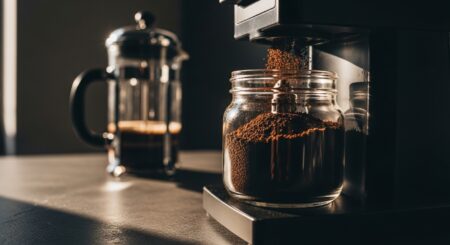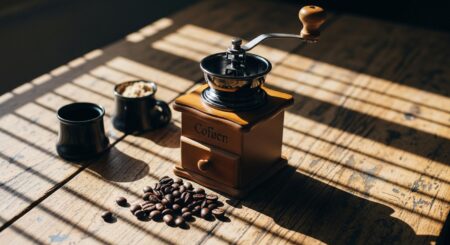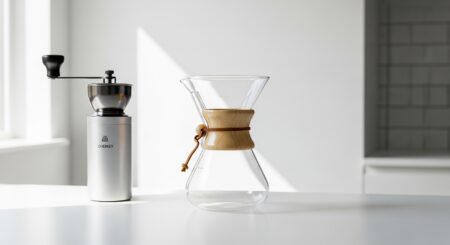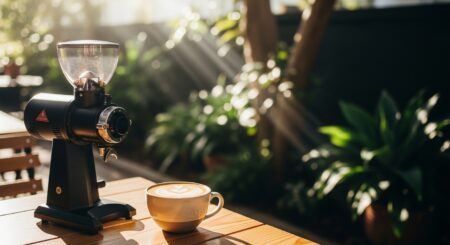


You’ve probably heard someone casually drop the phrase burr coffee grinder while you’re just standing there holding a bag of beans wondering why your coffee still tastes… kinda off, even tho you swear you did everything right. And yeah, it’s annoying, because it feels like there’s some secret club you didn’t get the invite to.
So let’s just sit with it a second. Because if you’ve ever brewed coffee that looked fine but tasted weirdly bitter or flat or just not… there, there’s a good chance the grinder is the quiet culprit.
So… what is a burr coffee grinder really?
Alright, not gonna hit you with a textbook definition, because that’s not how people actually learn stuff.
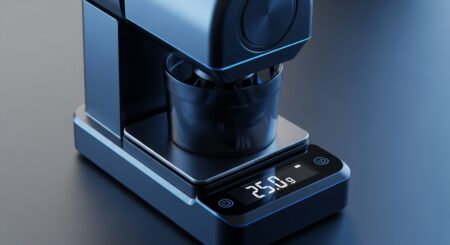
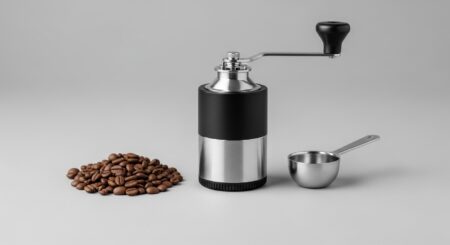
A burr coffee grinder is basically a machine that crushes coffee beans between two surfaces (called burrs) instead of slicing them up like a blender would. Sounds simple, but the way it crushes instead of chopping changes everything, like weirdly everything.
Instead of getting random chunks and dust (which happens with blade grinders), you get particles that are mostly the same size. And that uniformity, it’s not just a nerd detail, it’s what makes your coffee taste balanced instead of chaotic.
You know when one sip tastes strong and the next tastes kinda watery? That’s uneven grind size messing with you.
Blade vs burr grinders (the quiet battle nobody told you about)
People often start with blade grinders because they’re cheap and easy, but here’s what’s actually happening:
| Feature | Blade Grinder | Burr Coffee Grinder |
|---|---|---|
| Grind consistency | Uneven, random chunks | Even, controlled |
| Flavor outcome | Bitter + weak mix | Balanced, cleaner taste |
| Control | Basically none | Adjustable grind settings |
| Heat generation | High (can burn beans) | Lower, preserves flavor |
Blade grinders spin fast and chop beans like chaos. Burr grinders? They’re slower, more deliberate, almost like they care a bit more.
And yeah, coffee kinda notices that difference.
Why grind size actually matters (more than you think it does)
Here’s the thing that trips people up. Coffee isn’t just about beans or machines, it’s about extraction. That’s just a fancy way of saying: how water pulls flavor out of the grounds.
If your grind is uneven:
- Small particles (fines) over-extract → bitter taste
- Big chunks under-extract → sour or weak taste
So your cup ends up confused, like it couldn’t decide what it wanted to be.
With a burr coffee grinder, you get consistency, which means:
- Espresso tastes rich instead of harsh
- French press tastes full instead of muddy
- Pour-over tastes clean instead of… weirdly hollow
It’s not magic, but it kinda feels like it when you taste the difference for the first time.
Types of burr coffee grinders (and yeah, there’s more than one)
This is where things get slightly more complicated, but not in a scary way.
1. Flat burr grinders
Flat burr grinders use two parallel rings with sharp edges. Beans get crushed between them in a very controlled way.
They’re known for:
- Extremely consistent grind size
- Clear, bright flavor profiles
- Often used in cafes
But they can be louder and sometimes cost more than you’d expect.
2. Conical burr grinders
These use a cone-shaped burr inside a ring-shaped burr. Sounds odd, but it works really well.
They’re popular because:
- Quieter than flat burrs
- Produce less heat
- More affordable options available
A lot of home users end up here because it’s just… easier to live with.
Flat vs conical (quick comparison)
| Feature | Flat Burr | Conical Burr |
|---|---|---|
| Noise | Louder | Quieter |
| Cost | Higher | More budget-friendly |
| Flavor profile | Bright, precise | Rich, balanced |
| Maintenance | Slightly more involved | Easier |
Neither is “better” in a universal sense, it just depends on what you like and how deep you wanna go into coffee obsession territory.
Grind settings and why they’re kinda a big deal
One thing you’ll notice with a burr coffee grinder is the settings. There’s usually a dial or adjustment system that lets you control grind size.
And this matters more than people think.
Here’s a rough idea:
- Extra fine → Espresso
- Medium → Drip coffee
- Coarse → French press
But it’s not just about matching methods. It’s about tweaking until the taste clicks.
Sometimes you adjust one notch and suddenly your coffee stops tasting bitter and starts tasting like… actual chocolate notes or fruit or whatever your beans were supposed to have all along.
It’s a bit frustrating at first, not gonna lie, but also kinda addictive.
Real-world example: why cafes don’t mess around with grinders
Walk into any decent coffee shop and you’ll notice something: their grinders are massive, loud, and probably more expensive than your phone.
There’s a reason for that.
A study published in the Journal of Food Engineering found that grind uniformity directly impacts extraction yield and flavor clarity. In simple terms, better grind = better coffee.
Cafes invest in burr grinders because:
- They need consistency across hundreds of cups
- Customers notice bad coffee immediately
- Small differences add up fast
So when someone tells you the grinder matters more than the machine, they’re not exaggerating as much as it sounds.
Common mistakes people make with burr grinders
Even if you get a burr coffee grinder, there are still ways to mess things up (yeah, sorry).
1. Not adjusting grind size
People often set it once and forget it. But beans change, humidity changes, everything kinda shifts.
You gotta tweak it occasionally.
2. Using stale beans
No grinder can fix old beans. If your coffee smells like cardboard, that’s not the grinder’s fault.
3. Not cleaning the grinder
Oils build up over time, and that affects flavor.
Try to clean it every few weeks, even if you don’t feel like it.
4. Grinding too far in advance
Freshly ground coffee loses aroma quickly. Like, within minutes.
Grinding right before brewing makes a noticeable difference, even if you think it wouldn’t.
Is a burr coffee grinder worth it?
This is the part people hesitate on, because burr grinders cost more than blade grinders.
But here’s the honest answer:
If you drink coffee occasionally and don’t care much about taste, maybe not.
If you drink coffee daily and wonder why it never tastes as good as a café, then yeah, it’s probably worth it.
You don’t need the most expensive one either. Even a mid-range burr coffee grinder can drastically improve your coffee.
It’s one of those upgrades where you don’t realize how much it mattered until you try it.
How to choose the right burr coffee grinder
There’s a lot of options, and it can get overwhelming pretty quick. So instead of overthinking it, here’s a simple way to decide.
Think about your brewing method
- Espresso → need fine, precise grind control
- Pour-over → medium grind consistency matters
- French press → coarse settings are enough
Consider your budget
- Entry-level: good for beginners
- Mid-range: best balance of quality and price
- High-end: for people who are deep into coffee
Look for these features
- Adjustable grind settings
- Durable burr material (steel or ceramic)
- Easy cleaning mechanism
Don’t get distracted by too many extra features. Most of the time, simpler is better.
A slightly weird but useful analogy
Think of a burr coffee grinder like chopping vegetables with a sharp knife instead of just smashing them with something blunt.
Both technically “cut” the food, but one gives you clean, even pieces while the other just… destroys structure.
Coffee kinda reacts the same way.
Final thoughts (that might stick with you a bit)
If you’ve been feeling like your coffee should taste better but you can’t figure out why it doesn’t, there’s a good chance the grinder is the missing piece you didn’t know you were missing.
A burr coffee grinder isn’t some fancy upgrade for coffee snobs. It’s more like the baseline for making coffee that actually tastes like what it’s supposed to taste like.
And once you get used to that level of clarity in your cup, going back feels… off, like something’s quietly wrong and you can’t ignore it anymore.
So yeah, maybe that random person talking about grinders wasn’t being annoying after all. Or maybe they were, but they weren’t wrong either.